

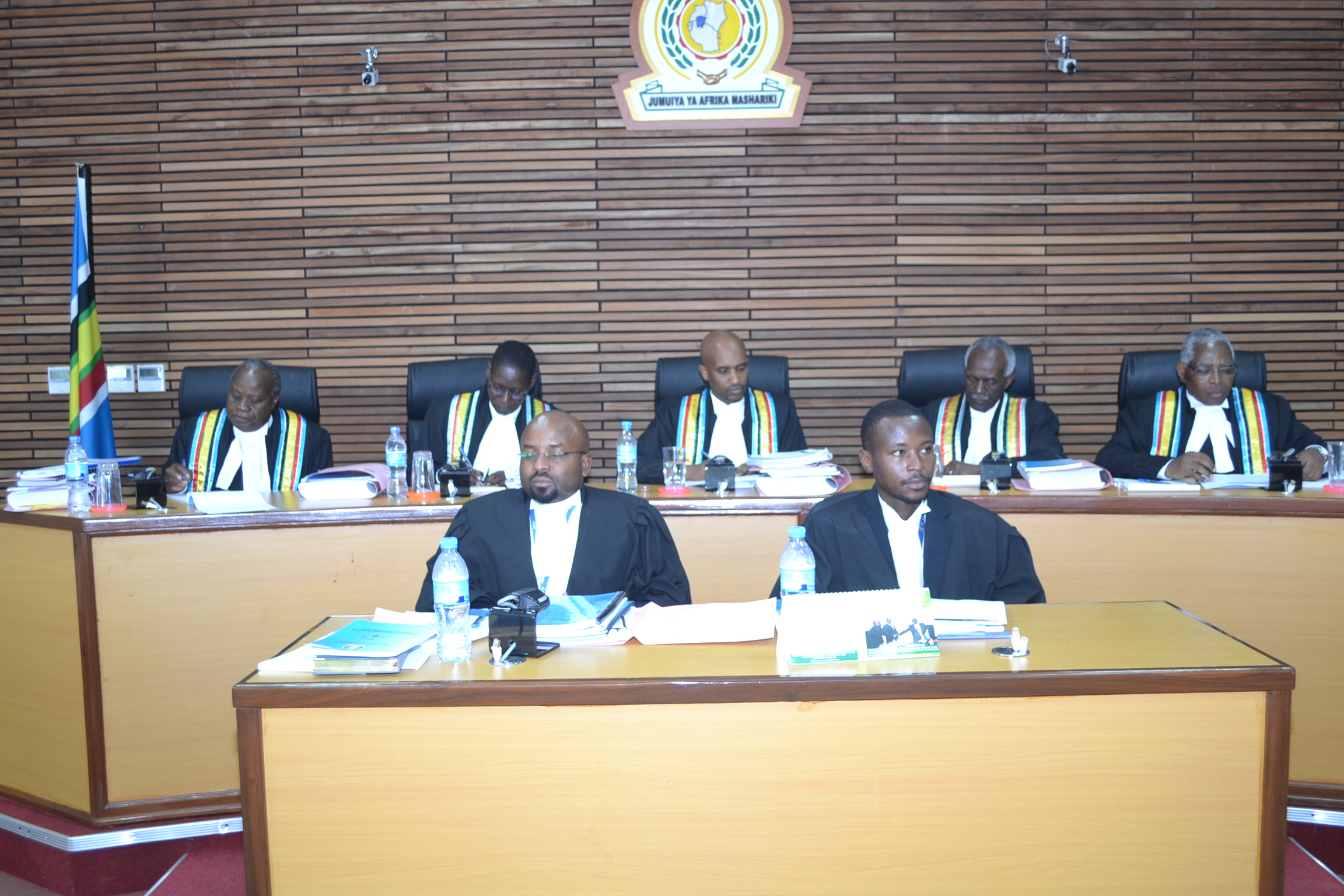

Lawyers in Court reading authorities submitted by the Appellant
East African Court of Justice Arusha, 26th January 2015: The East African Court of Justice Appellate Division heard an appeal filed by Democratic Party (Appellant) against the Secretary General of the East African Community (EAC) (1st Respondent) and the Attorney General’s of the Republics of Uganda (2nd Respondent), Kenya (3rd Respondent), Rwanda (4th Respondent) and Burundi (5th Respondent).
The matter is an appeal against a decision of the First Instance Division that was delivered on 26th November 2013 which dismissed the case. The case principally challenges the alleged failure by the Republics of Uganda, Kenya and Burundi (Respondents) to make individual Country declarations in acceptance of the competence of the African Court in line with Articles 5(3) and 34(6) of the Protocol to the African Charter on Human and People’s Rights on the Establishment of an African Court on Human and People’s Rights. It is urged that the alleged failure to do so is an infringement of Articles 5, 6, 7(2), 8(1)(c), 126 and 130 of the Treaty for the Establishment of the East African Community and Articles 1, 2, 7, 13, 26, 62, 65 and 66 of the African Charter on Human and People’s Rights and the aforesaid Protocol.
Mr. Justin Semuyaba Counsel for the Appellant submitted that, the lower Court error in its decision by stating that it has no jurisdiction to entertain the matter. He also submitted that, the African Charter is part and parcel of the EAC Treaty under Article 6 (d) and thus the Treaty allows the Court to look at the Charter. He further stated that, Partner States surrendered their sovereignty when entering into a Treaty. He also stated that, the EAC Partner States at the moment they came together under the EAC Treaty undertook an obligation to observe all international obligations. He further argued that, by upholding jurisdiction of the African Court, the 2nd, 3rd and 5th Respondents are infringing among other provisions Article 6 (d) of the EAC Treaty.
Dr. Anthony Kafumbe for the EAC Secretary General (1st Respondent) stated that, the lower Court arrived at a correct decision and it’s proper for the Appellate Division to uphold the decision. It was Counsel’s submission that, Article 23 sets out the role of the Court and 27 of the EAC Treaty spells out the Court jurisdiction which is to ensure adherence to law in the interpretation and application of and compliance with the Treaty and that the Court did not operate outside that framework. He also said that delay caused no violation because the Protocol doesn’t set time limit to deposit their declarations. Dr. Kafumbe also stated that Article 67(3) of the Treaty establishes the office of the Secretary General and spells out his functions and there is no provision that says he has to supervise Partner States in meeting their obligations. He further added that Article 29 of the Treaty gives the Secretary General a margin of appreciation therefore he has to be convinced that a Partner State has failed to fulfil its obligations under the Treaty. Dr. Kafumbe also submitted that Article 130 of the Treaty does not create obligations of the Secretary General to ensure that Partner States honour their commitments in respect of multinational and international organisations.
Dr. Kafumbe said there was no violation of the Treaty and urged the Court to uphold the decision of the lower Court and overrule the appeal.
Mr. Elisha Bafirawa Counsel for Uganda (2nd Respondent) submitted that, the language of Article 34(6) of the Protocol to the African Charter on Human and People’s Rights on the Establishment of an African Court on Human and People’s Rights is very clear that no time is spelt out for a State Party to deposit a declaration accepting the competence of the African Court. The framers of the Protocol left it out for the State Parties to determine when they should deposit. Counsel prayed that the Court find fit to dismiss the appeal.
Mr. Mwanji Njoroge Counsel for Kenya (3rd Respondent) submitted that Article 27 (1) of the EAC Treaty stipulates the Court’s jurisdiction. The provision does not extend the Court’s jurisdiction to include the African Charter. If the Court’s jurisdiction was extended it could have been officially announced. On the issue of delay, he referred to the lower Court finding that, since no time is set, Partner States are at liberty to deposit or not the declaration. It was Counsel’s submission that, it would not have been difficult for the framers of the Protocol to state otherwise. He requested the Court to uphold the decision of the First Instance.
Mr. Malala Aimable Counsel for Rwanda (4th Respondent) submitted that Rwanda has accepted the jurisdiction of the African Court and the Appellant dropped the case against it. However, he found it necessary to say that the lower Court did not error in its decision. He also stated that, the wording of Article 34(6) of the Protocol to the African Charter is very clear that “any time thereafter” the deposit of the declaration can be made. Thus according to Counsel it can be 2 years, 3 years and so forth, no time limit. Counsel asked Court for cost because they see no reason why Rwanda should continue to be dragged to the Court on this matter since they have accepted the jurisdiction of the African Court.
No appearance was made for the Republic of Burundi. All appeared before a full bench of the Appellate Division. The Court will deliver the Judgement on notice.
For editors
Article 29 (1) of the Treaty for the establishment of the East African Community
Where the Secretary General considers that a Partner State ha s failed to fulfill an obligation under this Treaty or ha s infringed a provision of this Treaty, the Secretary General shall submit his or her findings to the Partner State concerned for that Partner State to submit its observations on the findings.
Article 67(3) of the Treaty for the establishment of the East African Community states that; The Secretary General shall be the principal executive officer of the
Community and shall:
(a) be the head of the Secretariat;
(b) be the Accounting Officer of the Community;
(c) be the Secretary of the Summit; and
(d) carryout such other duties a s are confer red upon him by this Treaty or by the Council from time to time.
Article 34 (6) of the Protocol to the African Charter on Human and Peoples’ Rights on the Establishment of the African Court on Human and Peoples’ Rights states that, At the time of the ratification of this Protocol or any time thereafter, the State shall make a declaration accepting the competence of the Court to receive cases under article 5 (3) of this Protocol. The Court shall not receive any petition under article 5 (3) involving a State Party which has not made such a declaration.
For more information, please contact:
Ms. Geraldine Umugwaneza Ag. Registrar
Email: umugwaneza@eachq.org
Owora Richard Othieno, Head of Department;
Corporate Communications and Public Affairs;
Tel: +255 784 835021; Email: othieno@eachq.org